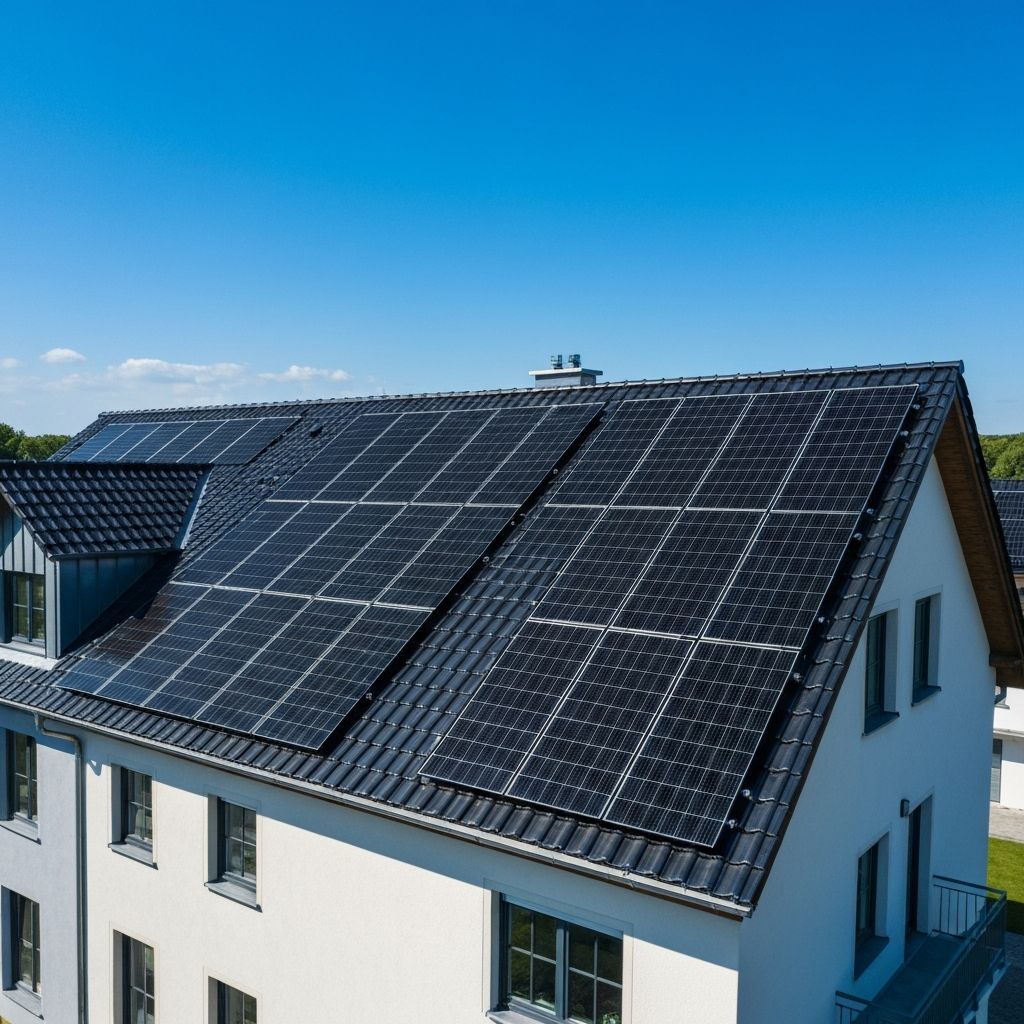
Can a Standard Solar Panel Become Roofing Material?
Why the next step in solar roofing may be standard PV modules, not custom panels
The short answer is yes - if the panel is given the right roofing integration. A standard PV module is already a weather-resistant element made from glass and aluminum. The real question in solar roofing is no longer only the module technology. It is how panels are connected to each other, to roof edges, and to penetrations in a way that creates a watertight, fire-safe, and maintainable roof system.
The missing link between roofing and solar
For years, the solar roofing market has tried to connect two worlds: roofing and solar power generation. Conventional rooftop PV uses standard solar panels mounted above an existing roof. It is low-cost, familiar, scalable, and bankable. Solar roofing aims to go one step further: the panel is no longer an additional layer above the roof, but part of the roof covering itself.
Historically, this has often been solved with custom modules. A special water channel, lock, seal, or edge detail is added to the module in the factory so it can behave like a roofing product. Technically, this is understandable. Commercially, it is expensive. Smaller production volumes, proprietary formats, dedicated certification paths, closed supply chains, and limited replaceability can make solar roofs many times more expensive than standard PV solutions.
This raises a simple question: is a custom solar module always necessary?
Modern standard PV modules are already made from materials designed for outdoor exposure. Glass does not let water through. Aluminum frames are built for weather. Glass-glass modules are protected on both sides by glass, and these modules have become increasingly common in standard rooftop PV. The technology used in rooftop solar is already very close to the technology used in solar roofing.
The difference is no longer mainly the panel. The difference is the connection.
Why glass-glass modules fit solar roofing logic
Solar roofing typically favors glass-glass modules. The reason is straightforward: a glass-glass module is mechanically stronger, more stable, and better suited to a situation where the panel must handle wind, snow, temperature changes, and long-term weather exposure.
Glass-glass modules also have an important fire-safety advantage: the outer surfaces of the module are glass. That means the external faces are non-combustible. Of course, the module still contains electrical components, encapsulants, junction boxes, cables, and connectors, so a glass-glass module does not make an entire roof automatically fireproof. But compared with older backsheet modules, glass-glass construction is a more logical base for solar roofing.
In recent years, glass-glass modules have also become increasingly normal in rooftop PV. This means that two markets - rooftop PV and solar roofing - are moving toward the same technological base.
One uses standard modules above the roof. The other can use essentially the same type of module inside the roof layer or as part of the roof covering. That means it is no longer reasonable to assume that solar roofing always needs a completely separate module industry. In many cases, the same technology can be used, but with a new roofing function.
The expensive part of a custom panel is not always the PV technology
Custom modules used in solar roofing often differ from standard modules not because the solar technology is fundamentally different, but because the roofing connection is added to the module itself.
The panel produces electricity in the same way. The glass protects the cells in the same way. The frame or edge structure provides stiffness in the same way. The cost increases when the module becomes a special format, manufactured in smaller volumes, with a factory-integrated waterproof locking system.
In other words, the cost of a solar roof does not rise only because the panel is better. It often rises because a standard PV product is taken out of the global standard supply chain and turned into a niche product.
This has been one of the central problems of solar roofing.
Rooftop PV became a mass-market product because it used standard modules, standard workflows, and standard financing logic. Solar roofing often moved in the opposite direction: custom modules, custom systems, more complex installation, and higher prices. If solar roofing wants to become a mass-market category, it has to move back toward standardization.
Holaroof logic: turn the panel into roofing material on the roof, not in the factory
Holaroof approaches the problem differently.
Instead of creating a new expensive solar roof module in the factory, Holaroof uses a standard framed PV module and turns it into part of the roof covering on site. The panel remains a standard product. The roofing function is created by the system around it: metal battens, clamps, seals, flashings, cable protection, edge details, ridges, eaves, valleys, and non-active filler panels.
This means the added value is not created inside the module factory. It is created in the roof system.
If the waterproof connection is built into the module in the factory, the panel becomes a custom module. If the waterproof connection is created on the roof with standardized system components, the project can use the existing PV industry supply chain. The result is a solar roof that combines the economics of a standard PV module with the function of a roof.
Why this gives solar roofing an advantage
A standard-module-based solar roof has several clear advantages.
First, it keeps the module cost low because it uses global PV manufacturing scale. Second, it reduces dependency on a single panel supplier. Third, it improves serviceability and future replacement options. Fourth, it is easier for investors, banks, and PPA partners to understand, because the energy-generating component is familiar and already bankable.
Most importantly, it makes solar roofing more scalable. If every country or market does not need a separate custom module supply chain, the focus can shift to what actually differentiates the product: roofing logic, installation speed, waterproofing, fire safety, cable protection, serviceability, and design software.
The panel is waterproof. The connection must become a roof.
A standard panel is already a weather-resistant element. Glass does not let water through. The problem is not the glass surface.
The problem is the connection.
Water does not usually enter through the glass. It enters through joints, edges, penetrations, poor slopes, weak flashings, or badly designed details.
Therefore, the real engineering task in solar roofing is not simply to invent a new panel. It is to apply roofing logic to PV modules: to make the joints between panels, the edges of the roof, ridges, eaves, valleys, penetrations, and transitions work like a true roofing system. The standard panel is the base module. The system makes it a roof.
Fire analysis changes the focus
Building a safe solar roof does not depend only on the specification of the module. Increasingly, the critical question is what happens below and around the module.
Fire analyses suggest that PV roof fires rarely start from the glass surface of the module or from the module as a whole. In the FRISSBE/ZAG guideline, a cited breakdown attributes only about 4% of ignition origins to PV modules. The majority of the risk is associated with DC isolators, DC connectors, inverters, and DC cables. The BRE UK investigation reaches a similar direction: recurring issues include isolators, connectors, inverters, cables, installation errors, and system design.
This changes the focus of solar roofing.
If risks are mainly born at system level, innovation should not focus only on creating a new module. Equally important - and often more important - is the world below the module: the fire performance of the substrate, cable routes, connectors, ventilation, water management, service access, and maintainability. The module itself is often the most standardized and best-tested part of the whole system. The real difference is whether the area below the module is a controlled roof system or an improvised risk zone.
A new category between BIPV and rooftop PV
This creates a new category between BIPV and rooftop PV.
It is not classic rooftop PV, where the panel is simply added above the roof. It is also not classic custom BIPV, where the product depends on an expensive proprietary module.
It is a standard-module-based solar roof.
If this logic works, it can strengthen the economics of solar roofing. Solar roofing no longer has to compete only on aesthetics, invisibility, or architectural purity. It can compete on the same arguments that made rooftop PV successful: price, payback, availability, serviceability, and financeability.
Final thought: two markets need to become one
Today, two massive markets operate side by side: roofing and rooftop PV.
Europe's roofing market has been estimated at close to 700 million square meters of annual shipments. That represents millions of new or renovated roof surfaces. At the same time, Europe adds tens of gigawatts of PV every year, and a large share of that capacity is installed on rooftops.
These are two large markets, but they still operate separately.
Because of this market failure, Europe and the world continue to build vast numbers of passive roofs every year - roofs that protect buildings but do not generate energy. Later, a separate PV system is often added on top. That means duplicated material, duplicated work, and duplicated responsibility.
Holaroof's goal is to bring these two worlds together.
The future roof should not be 'a roof plus a solar system'. The future roof should be one integrated category: active / non-active roof.
The active part produces energy. The non-active part solves the roof where energy is not produced: edges, penetrations, architectural zones, water protection, and visual continuity.
Together, they create one system, one logic, and one market.
This is not just a new product. It is the next step in roofing.
Holaroof is not reinventing the solar panel. Holaroof gives the standard PV module a new role - turning it into roofing material.
Sources and notes
- FRISSBE/ZAG, Fire Safety Guideline for Building Applied Photovoltaic Systems on Flat Roofs, May 2024.
- BRE, Fire and Solar PV Systems - Investigations and Evidence, Issue 2.9, 2018.
- Research and Markets / Arizton, Europe Roofing Market - Focused Insights 2023-2028, reporting 695.46 million square meters of roofing shipments in 2022.
- SolarPower Europe, EU Solar Market Outlook 2025-2030, reporting 65.1 GW of new EU solar PV installations in 2025.
Ready to Learn More?
Download our complete technical documentation or contact our team to discuss your project requirements.