01 · For You
I'm a Homeowner
Get matched with a certified installer in your area and receive a personalised quote.
Find an InstallerGet matched with a certified installer in your area and receive a personalised quote.
Find an InstallerJoin our partner network, access trade pricing, and grow your solar business.
Become a Partner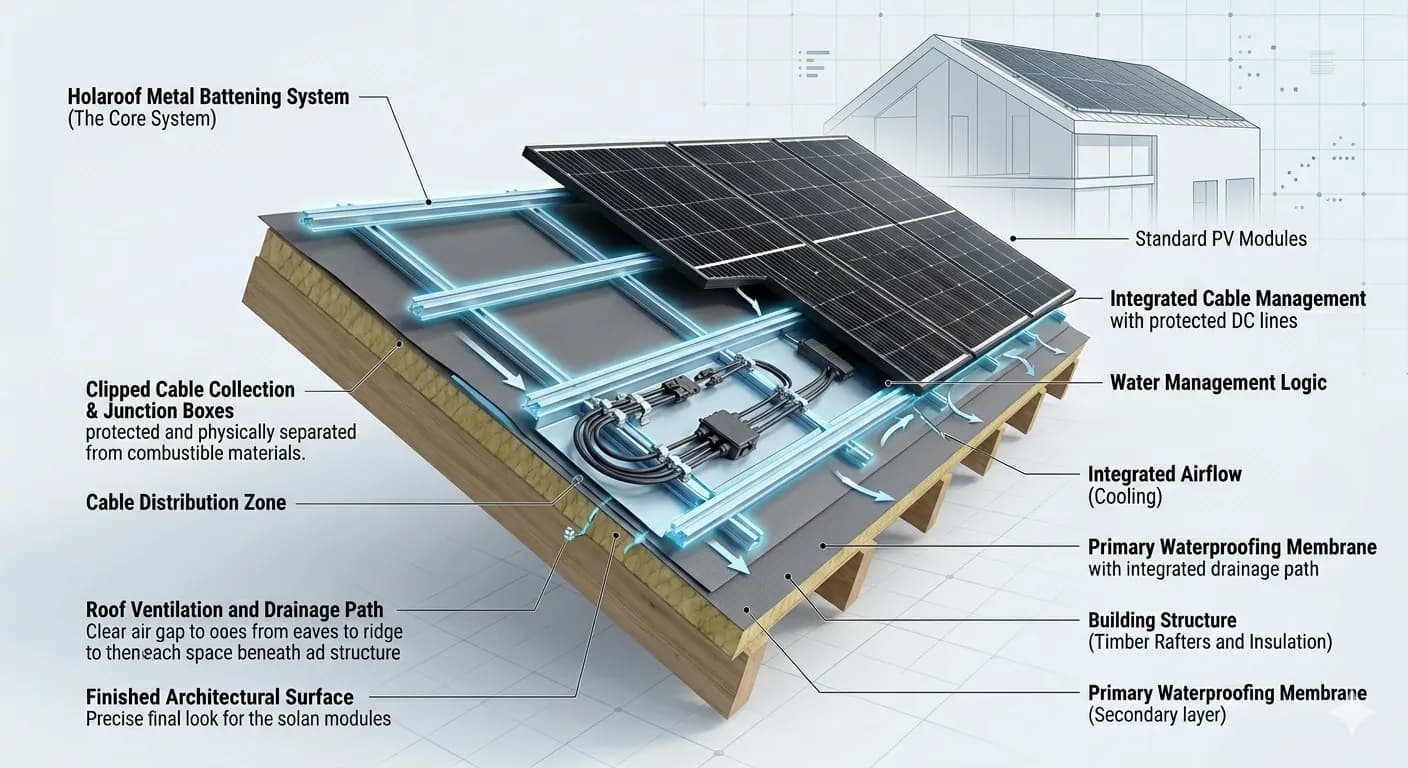
The core of Holaroof is not the solar module itself. It is the battening system that turns standard PV modules into a controlled roof assembly.
This battening system creates the safe underlay logic, the cable-management zone, the waterproofing path, the ventilation space and the finished architectural surface at the same time. Holaroof is therefore not simply a way to hold panels on a roof. It is the layer that makes standard solar modules behave like a roof.
That distinction matters because solar roof safety should not be an optional extra. It should be built into the system from the beginning -- and included in the price. Holaroof is designed around that principle.
Solar roofing is usually discussed through the visible parts of the system: modules, mounting, aesthetics, power output and payback. But one of the most important parts is often almost invisible. It sits beneath and between the panels: the underlay architecture.
In traditional roofing, the underlay is usually a secondary protection layer for wind-driven rain, condensation and small failures in the outer roof covering. In solar roofing, that is not enough. A solar roof is an active electrical system integrated into the building envelope, so the layer beneath the panels must help manage heat, moisture, fire risk, electrical separation, cable protection, long-term durability and responsibility between the solar system and the building structure.
A safe underlay should not be treated as an optional construction detail. It must be part of the solar roof system.
When people hear 'underlay', they often think of a membrane. That is part of the story, but not the whole story. In solar roofing, the underlay should be understood as the complete controlled layer beneath the PV surface: physical separation, waterproofing logic, ventilation space, cable route, support structure, fire-risk separation and fixing method.
This is where many solar roof systems become weak. The module may be certified, the inverter reliable and the outer surface clean. But if the zone beneath the panel is not controlled, the system still depends on hidden details that may be improvised on site.
The key questions are simple: where do the DC cables go; what protects them from abrasion, heat, moisture, animals and UV; what separates the electrical zone from combustible roof materials; where does condensation dry; how is water redirected if it enters the system; how are modules accessed later; and who is responsible if the roof-PV interface fails? These are not small construction questions. They are core solar roof questions.
A solar roof cannot be treated as a PV array placed into a roof-shaped hole. It has to be a complete roof-energy system.
The solar industry has made huge progress in modules, inverters, mounting systems and monitoring. The conversation around roof build-ups has not always kept pace.
In many projects, the PV system is designed by one party, the roof build-up by another, and the underlay is selected locally by the roofer or builder. That may work for conventional roofing, and sometimes for standard rooftop PV above an already finished roof. Roof-integrated solar is different.
When PV modules become part of the roof surface, the electrical system and the building envelope are no longer clearly separated. Cables, connectors, metal supports, ventilation gaps, waterproofing layers and structural materials form one combined risk environment.
If a connector overheats, a cable is damaged, moisture accumulates or a DC fault develops beneath the panel, the question is not only whether the outer roof surface has a fire classification. The question is what sits below the electrical zone: is it combustible, heat-tolerant, drainable, able to separate the active solar layer from the building structure and reliable for decades? If the answer is unclear, the solar roof system is incomplete.
Waterproofing remains essential. A solar roof must manage rain, wind-driven water, condensation, melting snow and drainage over time. But waterproofing alone is not enough.
The layer beneath the panels also acts as a safety and separation layer between an active electrical roof system and the structure below. In real buildings, that structure may include timber, insulation, bitumen, old membranes or other materials that behave differently under heat or fire conditions.
This is especially important in retrofit projects. A retrofit solar roof may be installed above an existing roof that is dry, structurally sound and watertight enough to remain in place. That can improve economics by avoiding demolition, waste handling and full roof reconstruction. But keeping the old roof in place creates a responsibility: the complete build-up must be assessed.
If the existing roof covering is combustible, ageing, bituminous, poorly ventilated or not suitable beneath an active PV layer, the underlay or separation layer becomes critical. It cannot be a generic membrane chosen at the end of the project. It becomes part of the safety architecture. A good solar roof does not hide these questions; it designs around them.
Traditional roof fire classifications are important, but they do not answer every question that matters for solar roofs.
Many real PV risks do not begin as external flames landing on top of the roof. They can begin below the module: in a connector, cable, junction box, damaged insulation, poor installation detail or overheated component.
That changes the logic. If ignition or overheating starts beneath the panel, the system must not offer an easy path into combustible materials. The safest approach is a stack of protective layers: non-combustible steel support, protected cable routing, grounding, arc-fault protection, serviceable modules and a suitable underlay or separation layer.
The underlay architecture is the final controlled barrier before the building structure. It should not add fuel to the risk zone, trap moisture, fail under realistic heat conditions beneath solar modules, or be selected without reference to the solar roof system above it.
Construction often presents a false choice: fast or safe. Solar roofing cannot scale if safety is treated as something that slows the project down, requires extra accessories or depends on expensive custom detailing every time.
The better answer is system design. A safe solar roof should be fast because the critical details are already solved: cable routes, fixing logic, ventilation space, water path, grounding and separation between electrical components and the building structure. The installer should not need to invent these details on the roof.
This is where the Holaroof battening system becomes central. It is not only a mounting rail. It is the repeatable interface that supports the modules, defines the cable-management zone, helps create the waterproofing logic, provides controlled ventilation, contributes to grounding and allows standard PV modules to become part of a clean architectural roof surface.
A system that is safe but slow will struggle to scale. A system that is fast but unsafe should not scale. A scalable solar roof must be both.
Many earlier solar-roof workflows split the job into two workfronts. One team, often roofers, built the wooden batten or underlay structure. Another team, often electricians or PV installers, later installed the modules and electrical system. On paper, that split looks logical. In practice, it creates a weak handover point exactly where precision matters most.
Field experience shows the problem. If the batten spacing, straightness or alignment is slightly wrong, the error may only appear when the second team arrives with panels and flashings. The team that built the hidden substructure may not be the team responsible for the visible PV roof surface, so the incentive to make the next work stage easy is weaker. Communication errors then become construction errors.
The result is familiar on real projects: re-measuring, re-fixing, waiting, rework and a delayed client site. The issue is not that roofers or electricians are careless. The issue is that the system itself creates an unnecessary transfer of responsibility between two trades.
Holaroof removes much of that handover logic. Its battening system follows rooftop PV logic: a trained PV installation team can install the controlled solar roof layer as one repeatable workflow. The same system that defines the underlay architecture also defines the module position, cable path, grounding, waterproofing logic and finished surface. Responsibility stays with the team building the solar layer.
The metal batten adds another practical advantage: it is factory-straight. A wooden batten often has to be selected, adjusted, forced or corrected on site. A metal batten does not need to be bent into straightness; it arrives as a precise reference line. That makes the roof faster to set out, easier to check and more accurate for module installation. In solar roofing, precision is not cosmetic. It decides whether the next row fits, whether flashings align, whether water paths work and whether the installer can keep moving.
In many building and energy markets, safety features are treated as optional extras: better cable management, better fire separation, better access, better documentation and better detailing. That logic is dangerous in solar roofing.
A solar roof is not a decorative product. It is a high-voltage electrical system integrated into the building envelope. The customer should not have to buy the 'safe version' as an upgrade. Safety should be part of the base system and part of the price.
This does not mean every project has the same roof build-up. Different buildings, slopes, climates, fire classifications and local regulations require different solutions. But the safety logic should not be optional. Cable protection, waterproofing, grounding, ventilation, serviceability and underlay compatibility are core functions -- not extras added later if the customer pays more.
Holaroof is designed around this principle. The product is not only the visible solar surface. It is the controlled architecture beneath it.
Safety is not the only issue. Durability also depends on the layer beneath the panels.
Solar roofs are expected to last for decades. PV modules are commonly sold with long performance warranties, but the roof build-up beneath the panels must be able to live in the same timeframe.
That means the underlay architecture must be compatible with long-term heat exposure, ventilation conditions, fixing methods, water drainage, condensation behaviour, roof slope, local climate and the materials above and below it.
A weak underlay can turn a good solar product into a bad roof. If it degrades, traps moisture, cannot tolerate temperature, or is punctured and left unsealed around fixings, the customer may not see the problem immediately. The issue can remain hidden until damage has developed inside the building envelope. A safe and durable solar roof should reduce hidden failure points, not create new ones.
There is also a financial reason why the underlay matters. For solar roofing to become mainstream, it must become bankable.
Banks, insurers, leasing providers and PPA companies do not only care about watts. They care about risk: what the asset is, how it performs, how it is maintained, who is responsible for failure and whether the system can operate reliably over time.
If the solar roof product stops at the panel and mounting system while the underlay is treated as an undefined local construction choice, responsibility becomes fragmented. If a problem occurs later, who is responsible: the module supplier, mounting supplier, roofer, membrane supplier, electrician, installer or customer? This uncertainty weakens the finance case.
A bankable solar roof needs clear system boundaries: defined layers, materials, installation rules, inspection points and maintenance logic. The underlay must be part of that definition. Otherwise, the solar roof is not really one system; it is several systems stacked together, with the most important interface left open to interpretation.
Holaroof is designed from a different assumption. The core product is not a special solar module. It is the battening system.
That system creates the controlled interface between standard PV modules and the building structure. It defines how water moves, where cables sit, how the system is grounded, how modules are supported, how ventilation is maintained and how the roof can be installed quickly without improvising critical details on site.
In conventional solar installations, mounting, waterproofing, cable routing, underlay and visual finishing are often treated as separate issues. In Holaroof, they are designed as one logic.
The battening system creates a safe and fast underlay architecture while supporting a weathertight and visually clean outer roof layer. Holaroof does not simply place panels above a roof. It creates the roof logic that allows standard PV modules to become part of the weather-protective surface.
Solar roofing cannot scale if every project depends on custom detailing, hidden cable routes, unclear responsibility between roofers and electricians, or handover points where the next work stage can fail. A scalable solar roof needs a repeatable, straight and controlled layer that manages the critical interfaces. For Holaroof, that layer is the metal battening system.
The solar roof market has often struggled because projects became too custom, too construction-heavy and too difficult to finance. One reason is that solar roofing has often been treated as a visual product: make the PV look like a roof.
The next generation must go deeper. It must define how the system behaves as a roof, as an electrical installation, as a fire-safety build-up, as a long-term asset and as a financed product.
The underlay architecture sits at the centre of those questions. It is where the active solar layer meets the building. If that interface is weak, the whole system is weak. If that interface is controlled, documented and designed as part of the system, solar roofing becomes safer, more durable and easier to insure, finance and scale.
A solar roof is not only a module, a mounting system, a fire classification or an aesthetic surface. It is a complete roof-energy system.
Every complete system needs a defined interface between the active electrical layer and the building structure beneath it. That interface is the underlay architecture.
A safe underlay must be part of the solar roof system because it may decide what happens when water enters, heat builds up, cables age, a connector fails, the roof moves, maintenance is needed, or an insurer or financier asks what the asset relies on.
Solar roofing has a strong future, but only if it becomes more than beautiful PV on a roof. It must become a controlled, safe and bankable roof system. That starts beneath the panels. And it must be designed into the system from the beginning -- not sold later as an accessory.
This article is general information, not a performance guarantee. Every installation requires a project-specific suitability, structural and electrical assessment in line with local building regulations and planning rules. Weathertightness, fire behaviour and output depend on the specified components, correct installation and the condition of the existing building. Third-party data and prices are accurate as at the date of publication.