01 · For You
I'm a Homeowner
Get matched with a certified installer in your area and receive a personalised quote.
Find an InstallerGet matched with a certified installer in your area and receive a personalised quote.
Find an InstallerJoin our partner network, access trade pricing, and grow your solar business.
Become a Partner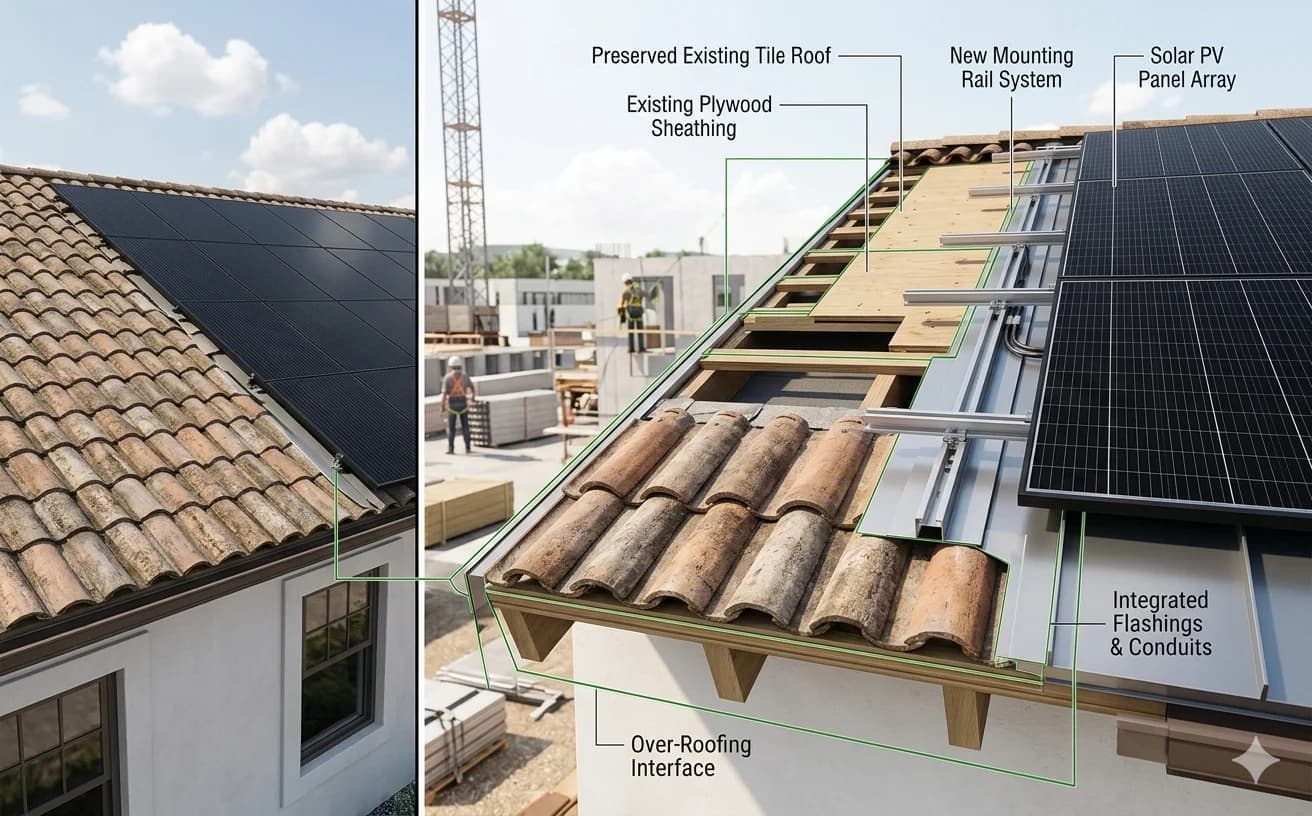
Solar roof retrofit: why keeping the old roof changes the economics.
Core idea: A solar roof does not always need to begin with demolition. Where the existing roof is dry, structurally sound, sufficiently watertight and risk-assessed, Holaroof can act as a new energy-generating layer above what already works.
Most solar roof systems start with an expensive assumption: the existing roof must be removed. That assumption changes the whole economics of the project.
Once the old roof is removed, the customer is no longer buying only a solar energy system. They are buying demolition, waste handling, temporary weather protection, new underlayment, roofing labour, PV installation, electrical work and coordination between several different trades.
This is one reason why solar roofing has often struggled to compete with standard rooftop PV. A conventional PV system can usually be installed on top of an existing roof. The roof remains in place, the building stays protected, and the solar installer adds an energy-producing layer.
Many solar roof systems have followed a more construction-heavy path.
But does a solar roof always need to start with demolition?
Not necessarily.
Layered construction is a well-established principle in building renovation.
In Northern Europe, ventilated facades are often installed over existing wall structures. In many countries, older roofs are renovated by adding a lightweight metal roofing layer above the existing roof, provided the original structure is sound.
The principle is simple:
If an existing layer still works, it does not always need to be destroyed. A new functional layer can be added above it.
Holaroof follows the same logic.
If the existing roof is structurally sound, dry, sufficiently watertight and suitable for additional load, Holaroof can be installed as a new energy-generating layer above the existing roof.
This does not mean every old roof is automatically suitable. Before installation, the roof condition, moisture risk, fixing points, ventilation, fire safety, structural load and local building requirements must be assessed.
If the existing roof is suitable, it can remain in place and continue to act as an additional protective layer beneath the new solar roof surface. The new Holaroof layer adds solar energy production, a fresh visual appearance and an additional weather-protective surface.
This changes the project from a full roof replacement into a solar roof retrofit.
A full solar roof replacement usually combines several jobs into one project.
The old roof must be removed. The building must be protected during construction. The underlayment must be rebuilt. The roofing system must be installed. The PV system must be electrically connected and commissioned.
That means demolition workers, roofers and PV installers may all meet on the same project.
Each trade adds cost, time and responsibility.
The biggest issue is not only material cost. The biggest issue is project complexity.
Removing the roof opens the building envelope. Weather becomes a risk. Scheduling becomes more sensitive. Mistakes can cause leaks. More labour is needed. Waste must be handled. The customer pays for all of this before the solar system has produced a single kilowatt-hour.
For many buildings, this is unnecessary.
If the existing roof still works, removing it can destroy value instead of creating value.
One point must be clear: retrofit is not a way to cover a failing roof.
If the existing roof is leaking, wet, rotten, structurally weak or at the end of its service life, the problem must be solved before a solar layer is added. In such cases, repair, partial opening or full replacement may be necessary.
Holaroof's retrofit logic is not about hiding risks. It is about avoiding unnecessary reconstruction when the existing roof is technically suitable and still performing.
Holaroof was designed around a different logic.
Instead of requiring the old roof to be removed in every case, Holaroof can be installed above suitable existing roofs as an additional layer. The system uses standard framed PV modules, metal battens, flashing details and protected cable routing to create a new solar roof surface.
In many cases, the load logic is comparable to standard rooftop PV, but every project still requires a site-specific structural assessment. Rafters, fixing points, wind loads, snow loads, the condition of the existing roof and local building regulations must all be checked.
The main difference compared with conventional rooftop PV is water management.
In a standard rooftop PV system, rainwater still mainly flows on the original roof below the panels. Dirt, leaves, bird nests, cable loops and other debris can accumulate beneath the array.
In a Holaroof retrofit, the solar layer becomes the visible surface. Rainwater is shed over the glass and controlled flashing details, while the suitable existing roof beneath remains the primary waterproofing layer, rather than water moving freely through a hidden space beneath the panels.
This helps reduce uncontrolled water, dirt and debris accumulation beneath the solar layer.
The old roof remains protected underneath, while the new surface adds energy production and a modern architectural appearance.
In a retrofit project, fire safety must be assessed as a complete roof build-up.
Holaroof's non-combustible steel battens, protected cable routes and grounding logic help reduce the risk of DC cables, connectors or other electrical components being placed directly against combustible materials. This matters because a solar roof is not just a roof covering. It is an electrical system integrated into the roof.
However, the existing roof covering may itself be combustible. Bitumen, old shingles, certain membranes or other organic layers can affect the fire behaviour of the complete system.
For that reason, a simple principle should apply to retrofit projects:
If the existing roof covering is combustible and remains beneath the electrical zone of the Holaroof system, the risk must be mitigated. The combustible layer should either be removed or separated from the solar roof system with a suitable non-combustible or fire-resistant underlay / separation layer.
In practical terms, a bitumen or other combustible roof layer should not remain directly beneath a new solar roof system without assessment and protection.
The solution may be:
The goal is not to say that every old roof layer must be removed. The goal is to avoid a situation where a high-voltage DC system, a potential cable fault and a combustible substrate are placed in the same risk zone without a protective layer.
Holaroof retrofit is best suited for roofs where the existing roof is dry, sound, structurally suitable and fire safety has been assessed.
A roof is not only a technical element. It is one of the largest visible surfaces of a building.
This is where many retrofit solar projects face a design problem. Standard rooftop PV adds panels above the roof, but often leaves the building looking like an old roof with a solar system placed on top.
Holaroof creates a different result.
The building receives a new, uniform and contemporary solar roof surface. The customer does not have to choose between "renovating the roof" and "installing solar". Both functions can be combined in one step.
This matters because many buildings do not need a full structural roof replacement. They need a refreshed exterior, better energy performance and lower operating costs.
A retrofit solar roof can deliver all three without unnecessary demolition, provided the existing roof is technically suitable.
The most important question in solar is still simple:
When does it pay back?
Solar roofing has often remained a niche because too much construction cost is added before energy production begins. If a project requires removing a working roof, rebuilding the underlayer and then installing a premium solar roof system, the payback period becomes harder to justify.
Keeping the old roof in place changes that calculation.
When demolition and full reconstruction are avoided, more of the budget can go toward the elements that actually improve the energy case: PV capacity, battery storage, smart energy management and financing.
This can shorten the payback period and make the solar roof easier to finance.
The economic logic is simple:
Do not spend capital destroying a roof that still works. Use that capital to generate, store and control energy.
There is also a practical construction advantage.
When the existing watertight roof remains intact during installation, the building is not exposed to weather in the same way as during a full roof replacement.
This reduces the risk of rain damage, temporary leaks and weather-related construction delays.
This can be especially valuable for homes, commercial buildings, hotels, schools, agricultural buildings and other properties where the building must remain operational during the works.
A solar roof retrofit can be faster, cleaner and less disruptive than a full roof reconstruction.
Some buildings cannot easily be altered.
Heritage-listed buildings, protected areas and architecturally sensitive properties may face restrictions on roof removal, material changes and visible interventions.
A reversible layered solution may create new options in some cases, because the original roof layer can remain in place while a new energy-generating roof surface is added above it.
This does not mean every protected building is automatically suitable for Holaroof. Local planning requirements, visual rules, structural conditions, fire safety and heritage approvals must always be reviewed.
But the principle matters:
A reversible solar roof layer can create options where full roof removal would be too invasive.
A solar roof retrofit is not suitable for every building.
Before installation, the existing roof must be assessed. The key questions are:
If the existing roof is leaking badly, structurally weak or at the end of its service life, it should not simply be covered. In such cases, the roof must be repaired or replaced before a solar layer is added.
If the existing roof covering is combustible, it must be assessed to determine whether that layer remains in the risk zone. If needed, the combustible layer should be removed or separated from the solar roof system with a suitable non-combustible underlay or separation layer.
Holaroof's retrofit logic is not about hiding problems.
It is about avoiding unnecessary reconstruction when the existing roof works and the risks are controlled.
The most important benefit is energy generation. The roof gains a missing function: it becomes an active energy-producing surface.
The second benefit is appearance. Holaroof creates a new, uniform roof surface instead of adding visible rack-mounted panels above an old roof.
The third benefit is payback. Avoiding demolition and reconstruction leaves more of the budget for PV, storage and energy management.
The fourth benefit is lower installation risk. The building envelope remains closed during installation, reducing the chance of weather damage.
The fifth benefit is compatibility. In many cases, the load and structural logic are close to conventional rooftop PV, although site-specific assessment is always required.
The sixth benefit is reversibility. For heritage and sensitive buildings, a layered solution may be less invasive than full roof removal.
The seventh benefit is controlled fire safety. If the existing layer is combustible, the project can be designed so that it is either removed or separated from the electrical solar roof zone with a suitable non-combustible underlay or separation layer.
Holaroof was developed around a simple principle: solar roofing should not require unnecessary demolition.
The system uses standard framed PV modules, metal battens and roofing-style flashing logic to create a new solar roof layer above a suitable existing roof. Where the existing roof is suitable, it can remain as a secondary layer, while the new Holaroof surface adds weather protection, energy production and a contemporary visual finish.
This is not a custom BIPV module approach. It is not full roof reconstruction by default. It is a practical retrofit model designed to bring solar roofing closer to the economics of standard rooftop PV.
At the same time, Holaroof retrofit is not a "just install it on top" solution. Every project must go through technical assessment: structure, moisture, fixings, ventilation, fire safety, electrical safety and local regulations.
If solar roofing wants to become a mass-market category, it must answer the same question that made rooftop PV successful:
Does it pay back?
Keeping the existing roof in place can be one of the most direct ways to improve that answer.
A solar roof does not always need to begin with demolition.
Sometimes, the smarter solution is to build the future layer above what already works - but only when the existing layer has been checked, confirmed as suitable and the risks have been mitigated.
This article is general information, not a performance guarantee. Every installation requires a project-specific suitability, structural and electrical assessment in line with local building regulations and planning rules. Weathertightness, fire behaviour and output depend on the specified components, correct installation and the condition of the existing building. Third-party data and prices are accurate as at the date of publication.