01 · For You
I'm a Homeowner
Get matched with a certified installer in your area and receive a personalised quote.
Find an InstallerGet matched with a certified installer in your area and receive a personalised quote.
Find an InstallerJoin our partner network, access trade pricing, and grow your solar business.
Become a PartnerThe material choice for a solar roof is not just an engineering decision. It determines how the product is manufactured, how fast it can scale, what its cost base is, how easy it is to install, and whether the system can ultimately become a financeable energy asset once certified. HolaRoof's choice is coated steel -- not a compromise, but an industrial strategy.
The solar energy market grew into a mass market through standardisation. Standard modules, repeatable installation processes, familiar components and understandable payback made rooftop PV a financeable energy production solution. Solar roofing has not scaled as quickly because too often it has moved in the opposite direction: special modules, proprietary formats, complex construction logic and a higher cost base.
HolaRoof starts from a different premise. The system uses standard framed PV modules and creates the roof logic around them: metal battens, clamps, flashing details, blind panels, protected cabling, grounding and serviceable installation. HolaRoof design principles describe the solution as an integration of standard PV modules with non-combustible steel battens (zinc-coated steel) as the substructure; HolaRoof is not installed on wooden battens and the battening is a galvanised or AluZinc steel profile, with cable, ventilation and water channels where needed.
The PV industry has relied on aluminium for decades for very good reasons. Aluminium is lightweight, highly extrudable, corrosion-resistant and familiar to installers. Module frames and many PV mounting systems have grown up in an aluminium logic.
But the PV market has changed. As solar energy moves from niche product to infrastructure, other questions begin to carry more weight: material price, local manufacturing, supply chain risk, carbon footprint, logistics, installation speed and financeability.
This shift is already visible. In 2024, pv magazine wrote about Origami Solar's steel PV module frames as an alternative to conventional aluminium frames; the company's frames had passed multiple third-party tests. In 2025, Nextracker acquired Origami Solar for approximately $53 million and justified the deal specifically as a move towards steel PV frames, emphasising faster installation, greater durability, recyclability and localised supply chains.
This does not mean the entire PV market is abandoning aluminium. The more accurate statement is: the market is quietly moving away from the idea that aluminium must be the automatic starting point for every PV structure. When the same function can be achieved with steel, with a better cost base and more local manufacturing logic, the material choice becomes strategic.
Plastic has its place in solar roofing. It is used in gaskets, insulating elements, EPDM details and places where flexibility or electrical isolation is required. But plastic is not suited to be the backbone of load-bearing, electrical and fire-safety-related roof architecture.
A solar roof is not a passive roof covering. It is a high-voltage DC system that operates for decades in an environment of UV radiation, temperature, humidity, wind, snow, mechanical load and electrical risks. When the same component must carry the panel, hold the cable, create a grounding path, tolerate heat, reduce fire load and remain dimensionally stable, metal is a far more logical material.
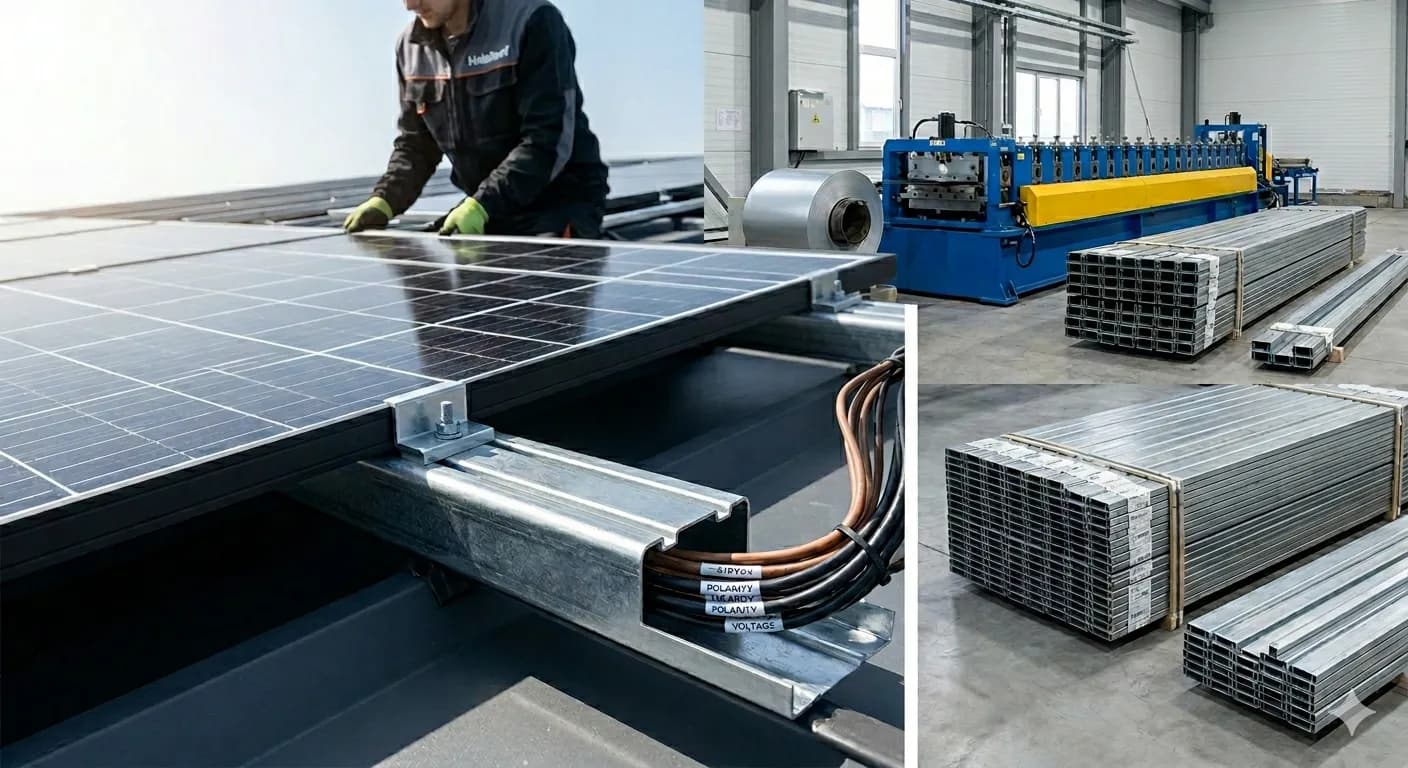
The HolaRoof metal batten is not simply a "rail". It is simultaneously a structural carrier, mounting platform and cable channel. The installation manual describes the metal batten as functioning as a structural carrier, mounting platform and cable management channel; the return bends on the batten edges act as integrated DC cable channels that help keep cables away from combustible materials.
Plastic can be a detail. It is not the backbone of a solar roof for HolaRoof.
Steel has one very direct advantage for HolaRoof: a stronger raw-material cost base.
A solar roof does not compete only with other roof coverings. It also competes with the economic logic of conventional rooftop PV. If the system wants to move from niche product to mass market, its cost base must be as close as possible to standard PV. Steel helps achieve this.
Metal markets in early May 2026 show the price base difference clearly. According to Trading Economics data, the aluminium price on 5 May 2026 was approximately 3,554 USD/t, while HRC steel was around 1,137 USD/t. These numbers are not a direct component cost comparison, as aluminium has lower density and profile geometry differs. But they clearly show the starting point: the raw material cost base for steel is economically strong for a load-bearing solar roof profile.
For HolaRoof, steel does not mean a heavier or clumsier system. According to the installation manual, the complete HolaRoof solution including an average PV module weighs under 15 kg/m2, placing it in the same weight category as a conventional on-roof PV system.
Therefore, the steel argument is not just "cheaper per kilo". With the right profile, it supports a better system cost base: lower material cost, simpler manufacturing, more compact logistics and better scalability.
One of aluminium's great strengths is extrusion. A heated aluminium billet is pushed through a die and the result is a precise and long profile. The International Aluminium Institute describes extrusion as a process where an aluminium billet is heated to around 500 degrees C and pushed through a steel die; Hydro describes the same principle through stages of heating, hydraulic pressing, shaped opening, cooling, straightening and cutting.
This is a very good manufacturing method, but it also creates a certain dependency. An extrusion plant, press capacity, dies, process control and often more centralised production are required. If the profile is a custom solution, the dependency becomes even greater.
Steel works according to a different logic. Coated steel coil can be roll-formed. Roll forming works cold: the sheet passes between successive rolls and is bent step by step into the desired profile. voestalpine Sadef describes roll forming as a process that takes place at room temperature, does not require heating the metal and can produce precise and complex profiles from sheet steel.
For HolaRoof, this is an important difference. Steel allows the use of existing sheet metal, roof profile and roll-forming industry. There is no need to build the entire business around one large special extrusion plant. Production can be from coil, locally and close to the market.
Steel is historically one of the most common construction and industrial materials in the world. It can be cut, bent, roll-formed, drilled, fixed, coated and repaired on almost every major construction market. According to the World Steel Association, global crude steel production in 2024 was approximately 1.89 billion tonnes. The same organisation describes steel as a highly recyclable and widely recycled material; approximately 680 million tonnes of steel were recycled in 2021.
This changes HolaRoof's manufacturing strategy. HolaRoof does not have to be just "one factory and one supply chain". Once the profile, tolerances, surface coating, tests and quality control are defined, manufacturing can be localised. Steel processing capability exists in the Nordics, Central Europe, Spain, the USA, India and many other markets.
This is exactly the logic the wider PV market is looking for. In 2024, Origami Solar announced partnerships with US steel manufacturers to produce steel PV frames regionally in Ohio and Texas; according to pv magazine, the goal was for frames to reach module manufacturers within one to two days.
For HolaRoof, decentralised manufacturing means even more. When the batten is steel and roll-formable, solar roof components can be brought closer to the installer. This reduces long transport, inventory risk, currency risk, geopolitical dependency and delivery time fluctuations. The solar roof becomes less of an "import profile" and more of a locally producible construction product.
Aluminium's historical corrosion advantage is real. There is no need to dispute this. But modern steel is no longer simply "steel that rusts". The question is about coating, environmental class and component design.
Zinc-magnesium and zinc-aluminium-magnesium coatings are increasingly used in PV substructures. ArcelorMittal describes Magnelis coating as a zinc, aluminium and magnesium-based solution that offers cut-edge protection and can perform up to ten times better than conventional galvanised steel. thyssenkrupp describes ZM Ecoprotect Solar coating as a zinc-magnesium coating designed for PV substructures, suitable for roll forming and use in different corrosion environments.
HolaRoof's CE and testing strategy follows the same practical logic. In coastal C3-C5 environments, material classes must be defined, such as EN 10346 Z275/Z600, appropriate A2/A4 fasteners must be used and steel-aluminium contacts must be solved with insulating washers or tapes to avoid galvanic problems.
Therefore, the right question is not "is aluminium corrosion-resistant and steel not?". The right question is: which coating, which environmental class, which cut-edge protection, which fasteners and which systemic detail? Modern coated steel can give a very strong answer to that question.
By density, aluminium is lighter than steel. That is a physical fact. But in a roof profile, you are not just buying density. You are buying stiffness, load capacity, shape, installation logic and weight per square metre.
Steel is a strong material and allows the use of thin, formed profiles. When the geometry is right -- edges, folds, channels, clamp seats, return bends and stiffening details -- a small amount of material can create a very rigid component.
This is the principle of the HolaRoof batten. The batten is not a massive beam but a multifunctional profile formed from thin coated steel. It carries, aligns, protects the cable, creates a mounting platform and helps with grounding logic. HolaRoof technical materials place the entire system weight close to the conventional rooftop PV load class.
Additionally, steel has lower thermal expansion than aluminium. The typical linear thermal expansion coefficient for carbon steel is approximately 10-12 x 10-6/K, for aluminium approximately 23 x 10-6/K. In practice, this means that a steel profile moves less with temperature change than an aluminium profile of the same length.
In solar roof logistics, not only the kilogram matters. Equally important are volume, length, packaging, handleability and damage risk.
Long aluminium rails may be convenient in production, but inconvenient in site logistics. They take up space in the warehouse, require longer transport, can be damaged during handling and create extra work on site. If the solar roof wants to scale to the mass market, the component must fit in a real installer's van and on a real construction site.
The HolaRoof batten is designed from the roof installer's logic in this respect. The installation manual describes battens as being produced in 2-metre sections so they can be transported in a standard van together with PV panel packages. On site, battens are connected with a locking overlapping edge that forms a straight and self-aligning batten line without special transport or ultra-long profiles.
Steel profiles can also be designed to be nestable. This means profiles can be placed inside each other or stacked very compactly. This reduces package volume, transport cost and warehouse space. For a solar roof where every square metre requires repeating details, such logistical simplicity becomes a direct cost advantage.
A solar roof is an electrical roof. This means the structure must do more than simply carry the panel.
DC cables, MC4 connections, grounding, potential equalisation, cable channels and serviceable access are part of the same system. When these details are left random, risk increases. When they are designed into the system, the solar roof becomes more controllable.
HolaRoof principles emphasise non-combustible steel battens, separate DC channels, abrasion protection, UV and temperature class, RSD/AFCI recommendation, SPD surge protection, potential equalisation and grounding. The same document emphasises that timber materials must be kept out of the structure.
This is one reason why plastic is not suitable as the main structural logic and why aluminium is not the only logical metal. A steel batten can simultaneously be structure, cable protection, part of the grounding path and installation template. This reduces hidden cable zones and helps keep electrical risk under better control.
Bankability does not just mean whether the product is technically interesting. It means whether the bank, insurer, developer, PPA provider or property owner understands the risks.
The financier looks at CAPEX, supply chain, installation risk, documentation, standard components, serviceability, spare parts, fire safety and warranty logic. Steel helps HolaRoof give a stronger answer on these points.
First, steel reduces the cost base. Second, it enables local production. Third, it uses material and manufacturing logic familiar to the construction market. Fourth, it does not lock the system into one extrusion plant. Fifth, it fits with HolaRoof's standard panel strategy.
HolaRoof USP materials emphasise that the solution is an open system: it does not lock the customer to one panel manufacturer but uses standard framed PV modules that the manufacturer approves for the intended use. The same document describes HolaRoof's business logic as close to conventional panel pricing and workflow logic, designed to be PPA- and lease-ready once MCS-certified.
This is important. A bank does not want to finance a product whose critical spare part depends on one closed manufacturer in ten years. It prefers a system where the PV module is standard, the metal profile is industrially producible, risks are documented and installation logic is repeatable.
Material choice is no longer just about price and mechanics. Increasingly, material origin, carbon footprint and supply chain control are also being examined.
Primary aluminium production is energy-intensive. The International Aluminium Institute describes the energy intensity of primary aluminium smelting through the Hall-Heroult electrolysis process electricity consumption per tonne of aluminium. This does not mean aluminium is a "bad" material. Recycled aluminium and low-carbon production are important. But for PV structures, it is legitimate to ask whether every profile must be extruded aluminium.
Steel also has a carbon footprint, but steel's extensive recycling, local manufacturing capability and coil-based production give a strong strategic advantage. This is precisely why the topic of steel PV frames has risen to the table of major market players. When acquiring Origami Solar, Nextracker emphasised not only durability and installation speed but also recyclability and local supply chains.
For HolaRoof, this argument is even broader than the module frame. The steel metal batten is part of the entire roof architecture. When it can be produced with local steel coil and existing roll-forming capability, the solar roof becomes less dependent on a long global special profile supply chain.
HolaRoof does not choose steel because aluminium is bad. HolaRoof chooses steel because the solar roof must move from premium niche to mass market.
The mass market needs a material with a strong price. A material that can be sourced from different markets. A profile that can be produced locally. A coating that can be designed according to environmental class. A load-bearing steel substructure that does not add combustible material to the high-voltage electrical zone. Logistics where battens fit compactly in packages and in a standard installer's van. Installation where components are repeatable, standardised and controllable.
Steel fits this logic.
Aluminium will remain in the PV industry. Plastic will remain in gaskets and auxiliary details. But the backbone of a HolaRoof solar roof must be strong, non-combustible, locally producible, serviceable, logistically simple and financeable.
That is why HolaRoof is made of steel.
This article is general information, not a performance guarantee. Every installation requires a project-specific suitability, structural and electrical assessment in line with local building regulations and planning rules. Weathertightness, fire behaviour and output depend on the specified components, correct installation and the condition of the existing building. Third-party data and prices are accurate as at the date of publication.